

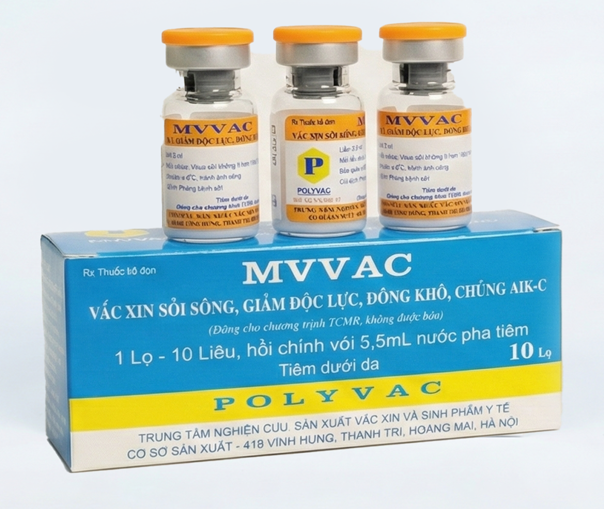
Measles Vaccine (MVVAC)
Measles Vaccine (MVVAC) is a live, attenuated virus vaccine produced on primary SPF chick embryo cells. Each 0.5ml dose contains not less than 1000 PFU of Measles vaccine virus strain AIK-C and contains not more than 10 µg each of antibiotics Erythromycin and Kanamycin.
This is an opaque white lyophilized product produced on a modern technology line, meeting World Health Organization standards for injectable Measles vaccine. When used, it must be reconstituted with the accompanying water for injection.
- Measles Virus AIK-C strain: ≥1000 PFU
- Dosage: 0.5ml/dose
- Target: Children from 9 months of age
- Route of injection: Subcutaneous (do not inject intravenously)
- Dosage form: Opaque white lyophilized powder
- Antibiotics: Erythromycin and Kanamycin (≤10µg each)
- Storage: ≤8°C and avoid light
- Shelf life: 24 months (lyophilized), 6 hours (after reconstitution)
- Quy cách: 1 liều/lọ hoặc 10 liều/lọ
- Contraindications: Pregnant women, immunodeficiency
Product Information
This section provides you with detailed information on ingredients, dosage, usage, indicated subjects and important notes when using MVVAC measles vaccine. You will find full instructions on storage, contraindications, undesirable effects as well as necessary warnings to ensure safety and effectiveness when vaccinating.
Each 0.5mL dose contains:
| Ingredients | Dose |
|---|---|
| Live attenuated Measles virus, AIK-C strain | ≥1000 PFU |
| Stabilizer: | |
| Lactose | 2% |
| D-Sorbitol | 0,72% |
| L-Sodium glutamate | 0,4% |
| Hydrolized Gelatin | 0,36% |
| Antibiotic: | |
| Antibiotic: Erythromycin | ≤ 10 µg |
| Kanamycin | ≤ 10 µg |
Lyophilized powder for injection.
Measles vaccine is indicated for active immunization against Measles.
The indicated subjects are children from 9 months of age and older and people who do not have Measles antibodies.
The vaccine can be indicated for active immunization against Measles for subjects from 06 months of age when:
- As part of providing enhanced services during a measles outbreak.
- When children are at high risk of measles.
- For migrant, refugee populations or in conflict zones.
- For migrant children from countries with measles outbreaks.
- In case of hypersensitivity to any component of the vaccine.
- Pregnant women.
- In case of acute respiratory infection, progressive untreated tuberculosis or immunodeficiency.
- People with malignant diseases.
Injection route: Measles vaccine is only injected subcutaneously. Do not inject intravenously
Injection dose: 0.5ml/dose.
Injection schedule: The first dose is injected for children from 9 months of age and older and the second dose is repeated according to the EPI schedule. For areas with measles epidemics or areas with high risk of measles, the first dose is injected for children from 6 months of age and the next dose is injected according to the recommendations of the EPI program. Adults can be vaccinated at any age.
Injection method:
- Prepare fully sterile injection equipment meeting standards.
- During the operation, do not let contamination get into the equipment and must change needles and syringes for each person.
- After use, syringes and vaccine vials must be collected in medical waste bins and treated according to regulations for medical waste.
Type of 10 doses/vial:
- Use a 10ml syringe to draw 5.5ml of water for injection, inject into the vaccine vial, shake well. Observe with the naked eye, the vaccine cake is completely dissolved, the vaccine solution is clear, no unusual color, no turbidity or foreign objects.
- Use a 1ml syringe to draw 0.5 ml of vaccine to inject 1 dose subcutaneously
Type of 1 dose/vial:
- Use a 1ml syringe to draw 0.7ml of water for injection, inject into the vaccine vial, shake well. Observe with the naked eye, the vaccine cake is completely dissolved, the vaccine solution is clear, no unusual color, no turbidity or foreign objects.
- Use a 1ml syringe to draw 0.5 ml of vaccine to inject 1 dose subcutaneously.
Caution should be exercised in cases with a history of high fever, allergy, convulsions, brain damage, thrombocytopenia.
Vaccination should not be administered in case of fever or during treatment affecting the immune system (such as using drugs, blood transfusion or blood products..).
Only vaccinate children when the fever has been gone for at least 3 days and at least 4 weeks after finishing treatment affecting the immune system.
No serious side effects have been observed after MVVAC measles vaccination.
Possible side effects are pain, swelling and erythema at the injection site. These reactions are usually mild and disappear after 1-2 days of injection.
Systemic reactions such as fever, rash, cough and runny nose may also occur in some children and usually last from 1 to 3 days and resolve spontaneously without treatment.
There have been cases of mild diarrhea but there is not enough evidence to conclude the cause is due to the vaccine.
Very rare cases of convulsions, encephalitis or thrombocytopenia (occurrence rate ≤ 1/1,000,000).
Inform the doctor of undesirable effects when using the vaccine
Should not be used for pregnant women and avoid pregnancy for 30 days after vaccination. There is no evidence of the vaccine's effect on lactating women and breastfed children.
There is no data on drug overdose, do not use more than the indicated dose of the drug.
No influence.
Interaction
Measles vaccine can be administered with mumps, rubella vaccines without affecting the immune response of these vaccines. Can be used simultaneously with combined Haemophilus type b vaccines, Hepatitis B vaccine or Diphtheria, Tetanus toxoid and Pertussis vaccine.
Some live, attenuated vaccines such as: OPV, smallpox, BCG... may affect the immune efficacy of measles vaccine. Therefore, when these vaccines have been injected, it is necessary to wait at least 4 weeks before injecting measles vaccine.
Incompatibility: Do not mix MVVAC vaccine with other vaccines in the same syringe