
PROJECT OVERVIEW
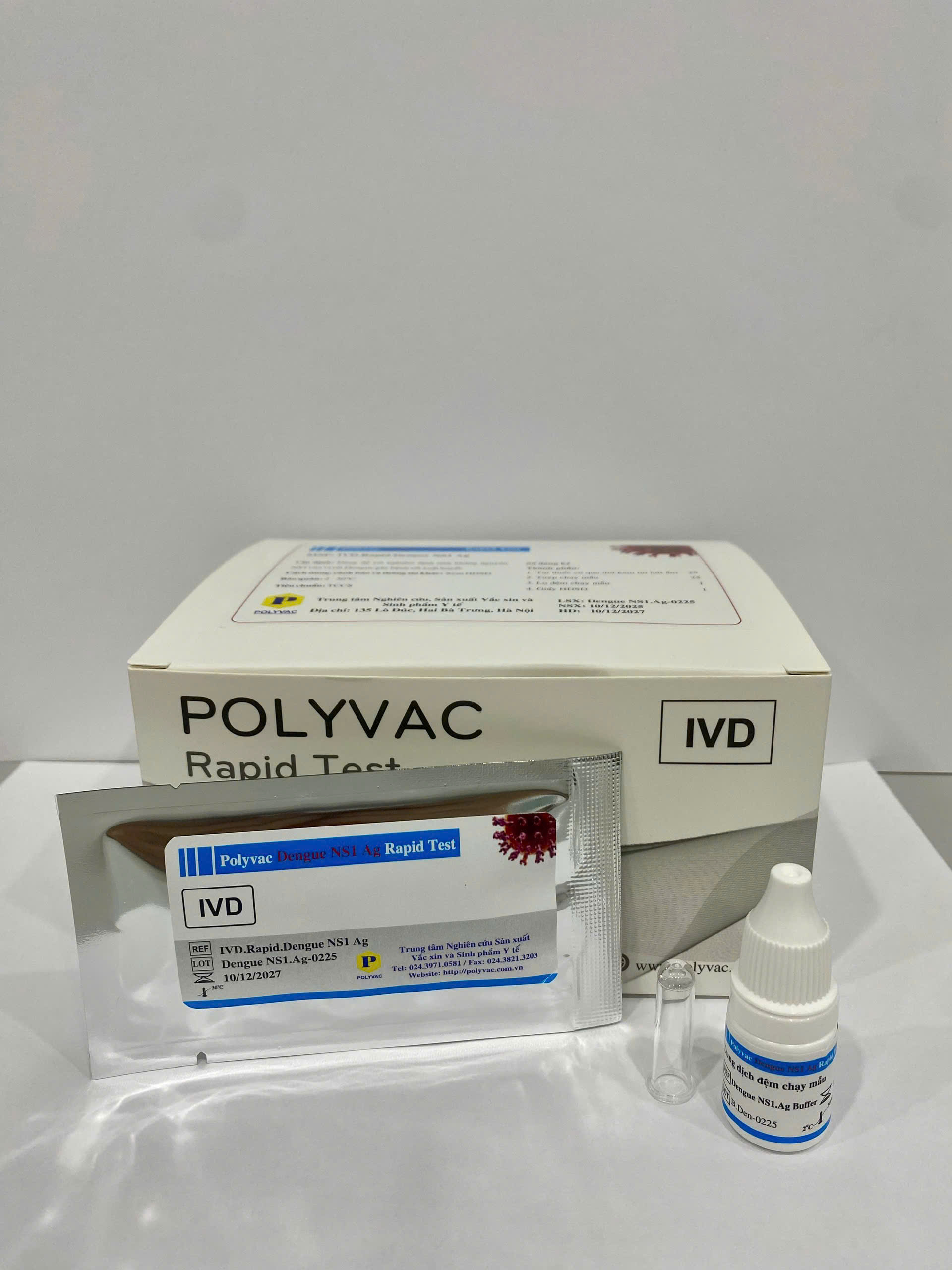
The product "Polyvac Dengue NS1 Ag Rapid Test" was developed at the Center for Research and Production of Vaccines and Biologicals (POLYVAC).
Research Details
- TOPIC NAME Polyvac Dengue NS1 Ag Rapid Test
- Classification Product Under Development
General Information
What is the Polyvac Dengue NS1 Ag Rapid Test?
- Dengue Hemorrhagic Fever (DHF) is a dangerous acute viral infectious disease transmitted from infected patients to healthy individuals primarily through Aedes aegypti and Aedes albopictus mosquitoes carrying the virus [2]. The causative agent is the Dengue virus of the Flaviviridae family, comprising four serotypes: DEN-1, DEN-2, DEN-3, and DEN-4 [1]. Currently, there is no specific treatment for the disease; therefore, the most effective preventive measure is to control and prevent vector transmission [3]. Based on disease severity, the World Health Organization (WHO) classifies DHF into three levels: DHF, DHF with warning signs, and severe DHF [3].
- Several diagnostic methods for Dengue virus infection have been used, including ELISA, Real-time PCR, and immunochromatography. This rapid test detects the presence of Dengue virus NS1 antigen in serum/plasma samples, supporting the definitive diagnosis of Dengue virus infection.
- The Dengue NS1 Antigen Qualitative Rapid Test is based on immunochromatographic principles for the qualitative detection of Dengue virus NS1 antigen in serum/plasma samples. This test aids in the diagnosis and screening of Dengue virus infection.
Operating Principle
- Mouse anti-Dengue NS1 antibodies are conjugated with colloidal gold nanoparticles and adsorbed onto the conjugate pad. Mouse anti-Dengue NS1 antibodies are immobilized at the test line position (T) of the test strip. Goat anti-mouse antibodies are immobilized at the control line position (C).
- When Dengue virus NS1 antigen (serotypes 1-4) is present in the sample, it forms an NS1 protein (serotypes 1-4) - anti-NS1 antibody - gold nanoparticle complex. This complex migrates along the nitrocellulose membrane by capillary action to the test line (T), where it is captured by anti-NS1 antibodies, forming an anti-NS1 antibody - NS1 protein (serotypes 1-4) - anti-NS1 antibody - gold nanoparticle complex that produces a visible line at the T position, indicating a positive result.
- The remaining conjugate (anti-NS1 antibody - gold nanoparticles) not captured by the antibodies continues to migrate to the control line and is captured by goat anti-mouse antibodies, producing a signal at the C line position, confirming proper test function.
- Thus, when signals appear at both the test line (T) and control line (C), the sample is positive for Dengue virus NS1 antigen. When only one line appears at the control position, the sample is negative for Dengue virus NS1 antigen.
Materials Required But Not Provided
- Timer
- Pen
- Tube rack
- Gloves
- Face mask
- Pipet
- Pipette tips
Warnings and Precautions
- Read the instructions carefully before performing the test. Incorrect procedures may lead to inaccurate results.
- Check for integrity before use. Do not use the test kit if the foil pouch is punctured, torn, or missing the desiccant sachet.
- Allow all test components to reach room temperature before use.
- Remove the test device from the pouch only when ready to perform the test.
- Do not reuse the test kit.
- Do not use the test kit after the expiration date.
- Do not use the test kit if it has not been stored according to instructions.
Packaging Specifications
- Store unused test devices and product components at 2-30°C.
- When stored at 2-8°C, ensure that test strips and components are brought to room temperature before use. Do not freeze or expose the device to temperatures above 30°C. Do not use the device beyond the expiration date printed on the packaging.
Sample Collection and Preparation
To prepare the specimen from serum/plasma sample, follow this procedure:
- Step 1: Collect 1-2 mL of patient blood into a tube without anticoagulant for serum separation or into a tube with anticoagulant for plasma separation.
- Step 2: Leave the blood tube at room temperature for 30 minutes to allow serum/plasma separation.
- Step 3: Centrifuge at 3,000 rpm for 10 minutes. Collect the serum/plasma into a storage tube and store at -20°C until testing.
Test Procedure
- Step 1: Ensure the specimen and test strip are at room temperature before testing. After the sample is thawed, mix thoroughly before performing the test.
- Step 2: Place the sample running tube in the tube rack and position on a flat surface.
- Step 3: Add 2 drops (60-80 µL) of buffer solution into the sample running tube.
- Step 4: Use a pipette to add 30 µL of sample into the sample running tube (already containing buffer solution) and mix thoroughly with the pipette.
- Step 5: Open the foil pouch, remove the test strip, and insert it into the sample running tube.
- Step 6: Start the timer.
- Step 7: Read the results after 15 minutes. Do not read results after 15 minutes as they may no longer be accurate.
Quality Control
The control line (C) is integrated into the test strip to verify the test procedure. Negative and positive control standards are not provided with the test kit. However, if necessary, quality can be verified using negative and positive control samples in the laboratory to confirm the procedure and product performance.
Result Interpretation
1. NEGATIVE: Only one pink-purple line appears at position C. Result: Negative for Rota virus.
2. POSITIVE: Khi vạch hồng tía xuất hiện ở cả 2 vị trí T và C, kết quả Dương tính với kháng nguyên NS1 của vi rút Dengue. Cường độ vạch T có thể đậm, nhạt phụ thuộc hàm lượng kháng nguyên NS1 của vi rút Dengue có trong mẫu
3. INVALID: When no pink-purple line appears at position C in the result window.
Positive results should be interpreted in conjunction with clinical presentation and other available data by the physician.
Test Limitations
- A negative result indicates the absence of detectable Dengue virus NS1 antigen in the sample. However, a negative result does not exclude the possibility of Dengue virus infection, as the NS1 antigen level in the sample may be below the detection limit of the test.
- A positive result confirms the presence of Dengue virus NS1 antigen but does not exclude the possibility of co-infection with other pathogenic microorganisms.
- Test results should be interpreted in conjunction with other laboratory test results, epidemiological information, and clinical presentation.